
Preparation of Haloalkanes

Body

A halogen derivative of an alkane is called a Haloalkane, where the hydrogen is replaced with a halogen.
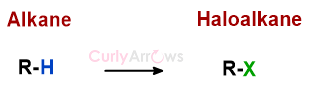
 

alkane to haloalkane


The common or the trivial name is Alkyl Halide.

A fun mnemonic to remember a few common preparation methods of haloalkane is hidden in the common name.


Mnemonic : AAAlkyl Halide (Alkane, Alkene, Alcohol, Halogen transfer)


The preparation of a haloalkane (or the alkyl halide) can be done from starting materials alkane, alkene, alcohol, and replacement of halogens by halogen transfer reactions.

Alkanes are very stable, inert molecules that undergo only a few reactions - cracking (breaking down a larger carbon chain into smaller carbon fragments), combustion (oxidation of an alkane to give carbon dioxide and water molecules), and free radical halogenation reactions (replacing Hydrogen of an alkane with halogen).

Here the preparation of haloalkane from alkane using free radical halogenation method will be covered. 


Preparation of Haloalkane from Alkanes- Free Radical Halogenation

General Reaction 

For free radical halogenation, an alkane is reacted with the halogen in the presence of a catalyst, UV light, or sunlight. In the absence of a light source, a very high-temperature condition of 520 K -670 K is used.
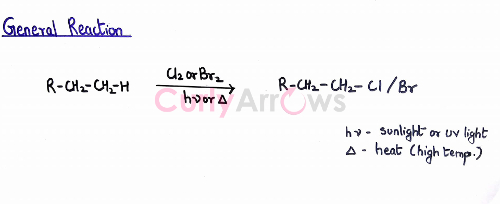
 

General Reaction alkane halogenation


Halogen Reactivity in Halogenation Reaction

The order of the halogen reactivity is-


F2 > Cl2 > Br2 > I2


Most halogenation reactions are done using Cl2 or Br2.  

Reactions with F2 are highly reactive, explosive, and hard to control.

In contrast, the reactions with I2 are very sluggish and reversible. Reversibility is due to the formation of by-product HI along with the desired iodoalkane.
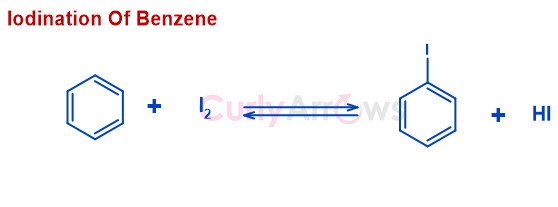
 

iodination of alkane reversisble


One solution is to use an oxidizing agent such as - HNO3, HgO, etc., converts HI formed back to I2.  An increase in the I2 concentration pushes the reaction in the forward direction (according to the Le Chatelier principle) to obtain more iodoalkane. (Read why iodination of benzene is difficult)


Formation of polyhalogenated products- A serious concern

The halogenation reaction using Cl2 or Br2 gives a mixture of mono, di, and polyhalogenated products.

The number of products formed depends on the number and type of replaceable hydrogens.

For example, methane (CH4) has four hydrogens, and it can form four different (mono, di, tri, tetra) halogenated compounds. 


The maximum number of replaceable hydrogens for a slightly bigger carbon chain propane is eight. Therefore, there are twenty-two combinations of halogenated products that can be obtained in presence of excess halogen. 


The formation of polyhalogenated compounds can be avoided if the alkane ratio to the halogen is decreased (1: 0.8 ratio) so that only a few halogens are available per molecule of alkane. The primary product would then be a mono halogen compound.

For a molecule like propane with more than two types of hydrogens (a and b), the issue doesn’t just stop there. There again is a possibility of forming two types of monohalogenated products.


Remember that halogenation reaction with alkane goes via a free radical mechanism. A radical, an electron-deficient species, follows the stability order like the carbocations- 3o> 2o> 1o. Therefore, the major product will be the one where the radical formed before the attachment of the halogen is most stable.

For propane, 2o radical formed is more stable than 10 radical to giving 2-chloropropane as the major product. 1-chloropropane obtained from a less stable primary radical will be the minor product.

Also, note that 2-chloropropane and 1-chloropropane are positional isomers with close boiling points and would be hard to isolate. 


Another example to explain the correlation between the type of the hydrogen and most stable product formed is for isopentane -


Isopentane has four types of hydrogen. However, 30 radical is the most stable, and the product formed using that will be the major product.

Therefore, selective halogenation for an alkane without giving side products is a major hurdle in free radical reactions.

Selectivity is seen for allylic or benzylic compounds where monohalogenation alkane is the major product.


In summary, free-radical halogenation reactions are hard to control. A mixture of desired monosubstituted and polysubstituted products is formed, making the purification and isolation of the desired compound a tedious process. Therefore, free radical halogenation of alkane is not a preferred way to halogenate a compound.

For making a fluoro or an iodoalkane, halogen transfer reactions are preferred.


Related Reading:  Free radical - Introduction, Structure, and Types, Types of equivalent hydrogen, Identification of allylic and benzylic positionIdentification of 1o, 2o and 3o alkyl groups  


Practice Problems

a) Identify the number of possible monobromo structural isomers expected to be formed on free radical monobromination of the following compounds (quiz)

b) Identify the number of dihalogen derivatives of the following compounds (quiz)

c) Predict the major product of free-radical bromination reaction (quiz)


Chemical Reactions and Mechanisms

Organic Chemistry Tutorials - CurlyArrows Premium

What is Organic Chemistry?

  • Introduction
  • Elements of a Chemical Reaction
  • Components of a Chemical Reaction

    Unlock Organic Chemistry


Atom

  • Size of an atom- The world belongs to the tiniest!
  • Power of Protons
  • Mass Number
  • Average Atomic Mass
  • Molecule and Molecular Mass
  • The Electrons- An Atom’s Reactive Component
  • Atomic Orbitals- s, p, d, f
  • Filing of Atomic Orbitals and Writing Electronic Configuration
  • Valence and Core Electrons- How to Determine

     Unlock Atom


Bonding In Atoms

  • Octet Rule - Introduction and Bonding
  • Limitations of Octet Rule
  • Ionic Bond- Introduction and Formation
  • Formation of Ionic Compound
  • Requirements for Ionic Bonding
  • Appearance and Nature of Ionic Compounds
  • Physical Properties of Ionic Solids- Conductance, Solubility, Melting Point, and Boiling Point
  • Covalent Bond - How it Forms
  • Covalent Bond - Why it Forms?
  • Covalent Bond - Bond Pair (Single, Double, Triple) and Lone Pair
  • Number of Covalent Bonds- Valency
  • Types of Covalent Bonds- Polar and Nonpolar
  • Metallic Bond - Introduction and Nature
  • Significance of Metallic Bonding
  • Impact of Metallic Bonding on the Physical Properties
  • Applications of Metallic Bonding
  • Difference Between Metallic and Ionic Bond

     Unlock Bonding in Atoms


Covalent Bond

  • Theories on Covalent Bond Formation
  • Valence Bond Theory- Introduction and Covalent Bond Formation
  • Valence Bond Theory- Types of Orbital Overlap Forming Covalent Bonds
  • Applications, Limitations, and Extensions of Valence Bond Theory
  • Hybridization- Introduction and Types
  • sp3 Hybridization of Carbon, Nitrogen, and Oxygen
  • sp2 Hybridization of Carbon, Carbocation, Nitrogen, and Oxygen
  • sp Hybridization of Carbon and Nitrogen
  • Shortcut to Determine Hybridization
  • The shape of sp hybrid orbital - Why is the lobe unequal?
  • VSEPR Theory- Introduction
  • Difference between Electron Pair Geometry and Molecular Structure
  • Finding Electron Pair Geometry and Related Shape
  • Predicting Electron-Pair Geometry and Molecular Structure Guideline
  • Predicting Electron pair geometry and Molecular structure - Examples
  • Finding Electron-Pair Geometry and Shape in Multicentre Molecules
  • Drawbacks of VSEPR Theory
  • Electron Wave Property, LCAO and MOT - Introduction
  • Linear Combination of Atomic Orbitals - Formation of Sigma and Pie bonds using MO Approach
  • The Energetics of Bonding and Antibonding Molecular orbitals
  • Conditions for the Valid Linear Combination of Atomic Orbitals  
  • Features of LCAO Theory
  • Finding the Electronic Configuration of Molecules using MO and Predicting Comparative Stability using Bond Order
  • Setting up the MO diagram for homonuclear diatomic molecules – Second Period Elements
  • Setting up the Molecular Orbital Diagram for Heteronuclear Diatomic Molecules
  • The Non-bonding Molecular Orbitals
  • Weakness of the Molecular Orbital Theory
  • Covalent bond Characteristics - Bond Length
  • Factors affecting Bond Length
  • How does Electron delocalization (Resonance) affect the Bond length?
  • Covalent bond Characteristics- Bond Angle
  • Factors affecting Bond Angle
  • Covalent bond Characteristics - Bond Order
  • How Bond Order Corresponds to the Bond Strength and Bond Length
  • Solved Examples of Bond Order Calculations
  • Covalent Bond Rotation
  • Covalent Bond Breakage
  • Covalent Bond Properties -Physical State, Melting and Boiling Points, Electrical Conductivity, Solubility, Isomerism, Non-ionic Reactions Rate, Crystal structure

     Unlock Covalent Bond


Electronic Displacement in a Covalent Bond

  • Electronegativity- Introduction
  • Factors Affecting Electronegativity- Atomic number, Atomic size, Shielding effect
  • Factors Affecting Electronegativity-s-orbitals, Oxidation state, Group electronegativity
  • Application of Electronegativity in Organic Chemistry
  • Physical Properties Affected by Electronegativity
  • Inductive effect - Introduction, Types, Classification, and Representation
  • Factors Affecting Inductive Effect- Electronegativity
  • Factors Affecting Inductive Effect- Bonding Order and Charge
  • Factors Affecting Inductive Effect- Bonding Position
  • Application of Inductive Effect- Acidity Enhancement and Stabilization of the counter ion due to -I effect
  • Application of Inductive Effect-Basicity enhancement and stabilization of the counter ion due to +I effect
  • Application of Inductive Effect-Stability of the Transition States
  • Application of Inductive Effect-Elevated Physical Properties of Polar Compounds
  • Is the Inductive Effect the same as Electronegativity?
  • Resonance - Introduction and Electron Delocalization
  • Partial Double Bond Character and Resonance Hybrid
  • Resonance Energy
  • Significance of Planarity and Conjugation in Resonance
  • p-orbital Electron Delocalization in Resonance
  • Sigma Electron Delocalization (Hyperconjugation)
  • Significance of Hyperconjugation
  • Resonance Effect and Types
  • Structure Drawing Rules of Resonance (Includes Summary)
  • Application of Resonance
  • Introduction to Covalent Bond Polarity and Dipole Moment
  • Molecular Dipole Moment
  • Lone Pair in Molecular Dipole Moment
  • Applications of Dipole Moment
  • Formal Charges - Introduction and Basics
  • How to Calculate Formal Charges (With Solved Examples)
  • Difference between Formal charges and Oxidation State

   Unlock Electronic Displacements in a Covalent Bond


Common Types of Reactions

  • Classification of common reactions based on mechanisms
  • Addition Reactions
  • Elimination Reactions (E1, E2, E1cb)
  • Substitutions (SN1, SN2, SNAr, Electrophilic, Nucleophilic)
  • Decomposition
  • Rearrangement
  • Oxidation-Reduction

     Unlock Common Types of Reactions


Drawing Organic Structures

  • Introduction
  • Empirical Formula
  • How to Calculate Empirical Formula from percentage composition and atomic masses
  • Related Numerical Problems - Finding Empirical Formula (Solved)
  • Molecular Formula
  • Numerical Problems related to finding molecular formula  (Solved)
  • How to calculate molecular formula from empirical formula and molecular masses
  • Hill Nomenclature - The Empirical and Molecular Formula Writing Rules
  • E/Z Nomenclature -  Structure Writing Rules for Substituted Alkenes
  • Kekulé
  • Condensed
  • Skeletal or Bond line
  • Polygon formula
  • Lewis Structures- What are Lewis structures and How to Draw
  • Rules to Draw Lewis structures- With Solved Examples
  • Lewis structures- Solved Examples, Neutral molecules, Anions, and Cations
  • Limitation of Lewis structures
  • 3D structure representation- Dash and Wedge line
  • Molecular models for organic structure representation- Stick model, Ball-stick, and Space-filling
  • Newman Projection- Introduction and Importance
  • How to Draw Newman Projections from Bond-Line Formula (5 step-by-step solved examples on alkane, substituted alkane, alkene, ketone, and cycloalkane)
  • Drawing Newman Projections to the Bond line Formula (solved examples)
  • Sawhorse Projection

     Unlock Drawing Organic Structures


Functional Groups in Organic Chemistry

  • What are functional groups?
  • Chemical and Physical Properties affected by the Functional Groups
  • Identifying Functional Groups by name and structure
  • Functional Group Categorization- Exclusively Carbon-containing Functional Groups
  • Functional Group Categorization- Functional Groups with Carbon-Heteroatom Single Bond
  • Functional Group Categorization- Functional Groups with Carbon-Heteroatom Multiple Bonds
  • Rules for IUPAC nomenclature of Polyfunctional Compounds
  • Examples of polyfunctional compounds named according to the priority order
  • Examples of reactions wherein the functional group undergoes transformations

     Unlock Functional Groups in Organic Chemistry


Structural Isomerism

  • Introduction
  • Chain Isomerism
  • Position Isomerism
  • Functional Isomerism
  • Tautomerism
  • Metamerism
  • Ring-Chain Isomerism

     Unlock Structural Isomerism


Intermolecular Forces

  • Ion-Dipole Interactions-Introduction and Occurrence
  • Factors Affecting the Ion-Dipole Strength
  • Importance of Ion-Dipole Interactions
  • Ion-Induced Dipole - Introduction, Strength and Occurrence
  • Factors Affecting the Strength of Ion-Induced Dipole Interactions
  • Ion-Induced Dipole Interactions in Polar Molecules
  • Vander Waals Forces -Introduction
  • Examples of Vander Waals' forces
  • Vander Waals Debye (Polar-Nonpolar) Interactions
  • Factors affecting the Strength of Debye Forces
  • Vander Waals Keesom Force - Introduction, Occurrence and Strength
  • Vander Waals London Force - Introduction, Occurrence, And Importance
  • Factors Affecting the Strength of London Dispersion Forces- Atomic size and Shape
  • Introduction, Occurrence and Donor, Acceptors of Hydrogen Bond
  • Hydrogen bond Strength, Significance and Types
  • Factors Affecting Hydrogen Bond Strength
  • Impact of Hydrogen bonding on Physical Properties- Melting and boiling point, Solubility, and State
  • Calculation of the Number of Hydrogen Bonds and Hydrogen bond Detection

     Unlock Intermolecular Forces


Physical Properties

  • Physical Properties- Introduction, Role of Intermolecular Forces
  • Physical State Change-Melting Point
  • Role of Symmetry, Role of Carbon numbers, Role of Geometry
  • Physical State Change-Boiling Point
  • Intermolecular Forces and their Effect on the Boiling Point, Role of Molecular Weight (Size), Molecular Shape, Polarity
  • Boiling Point of Special Compounds- Amino acids, Carbohydrates, Fluoro compounds
  • Solubility in Water
  • Density
  • Preliminary Qualitative Analysis of some Organic Compounds | Intensive Physical Property Measurements

     Unlock Physical Properties


Fundamentals of Organic Reactions

  • Types of Arrows Used in Chemistry
  • Curved Arrows in Organic Chemistry- with Examples
  • Electrophiles - Introduction, Identification and Reaction
  • Formation and Classification of Electrophiles- Neutral and Charged
  • Difference between Electrophiles and Lewis Acids
  • Nucleophiles - Identification and Role in a Reaction
  • Types of Nucleophiles- Lone Pair
  • Types of Nucleophiles- Pie Bond
  • Types of Nucleophiles- Sigma Bond
  • Periodic Trend and Order in Nucleophilicity
  • Introduction to Reactions Involving Nucleophiles
  • Nucleophile Reactions- Aliphatic Displacement type - SN1, SN2
  • Nucleophile Reactions- Acyl Displacement type
  • Nucleophile reactions- Aromatic Displacement type- Electrophilic, Nucleophilic
  • Addition Reactions- Electrophilic, Nucleophilic, and Acyl
  • Ambident Nucleophiles- Introduction and Formation
  • Ambident Nucleophile - Nature of the Substrate
  • Ambident Nucleophile- Influence of the Positive Counter Ions
  • Ambident Nucleophile- Effect of Solvent
  • Lone Pair - Introduction and Formation
  • Physical Properties Affected by the Lone Pair- Shape and Bond Angle
  • Physical Properties Affected by the Lone Pair- Hydrogen Bonding
  • Physical Properties Affected by the Lone Pair- Polarity and Dipole Moment
  • Chemical property affected by the Lone pair- Nucleophilicity
  • Leaving Group - Introduction and Nature
  • Good and Bad Leaving Group
  • Factors Determining Stability of the Leaving Groups- Electronegativity, Size, Resonance Stability
  • Using pKa as a Measure of Leaving Group Ability
  • Leaving Groups in Displacement Reactions
  • Leaving Groups in Elimination Reactions

     Unlock Fundamentals of Organic Reactions


Reactive Intermediates

  • Carbocation - Introduction, Nature, and Types
  • Formation of Carbocation
  • Stability of Carbocations- Inductive, Resonance, and Hyperconjugation
  • Other Structural Features Increasing Carbocation Stability
  • Structural Feature Decreasing Carbocation Stability
  • Fate of the Carbocation
  • General Carbocation Formation Reactions
  • Carbanion - Introduction, Nature, and Types
  • Formation of Carbanions
  • Carbanion Stabilization
  • Ease of Formation of Carbanion -Acidic proton
  • Fate of the Carbanion
  • Free Radical - Introduction and Types of Carbon-Centred Radicals
  • Structure of Carbon-Centred Free Radical
  • Formation of Radicals
  • Stability of the Carbon-Centred Radicals
  • Other Structural Feature Increasing Free Radical Stability
  • Comparing Free Radical Stability using Dissociation energies (D-H)
  • Fate of Free Radicals
  • Common Reactions Involving Carbon-Free Radicals

     Unlock Reactive Intermediates


Stereoisomerism - Conformation and Configurational Isomerism

  • Conformations in Organic Chemistry - An Introduction
  • How are Conformational Isomers Depicted
  • Open Chain and Closed Chain Conformations
  • Nomenclature related to sp3-sp3 and sp3-sp2 bond rotations
  • Conformational Analysis
  • Factors affecting the stability of conformers - Stabilizing Interactions |Hyperconjugation
  • Factors affecting the stability of conformers - Stabilizing Interactions | Intramolecular Hydrogen Bonding
  • Factors affecting the stability of conformers - Stabilizing Interactions | Dipole Minimizations
  • Factors affecting the stability of conformers - Destabilizing Interactions | Steric strain
  • Factors affecting the stability of conformers - Destabilizing Interactions | Torsional strain
  • Factors affecting the stability of conformers - Destabilizing Interactions | Angle strain
  • Importance of Conformational Analysis
  • Conformation in Compounds with Lone Pairs
  • Role of Solvents in Conformations
  • An Example of Conformation Dependent Reaction and Product Selectivity
  • Geometrical Isomerism - Introduction
  • Impact of cis-trans isomerism on physical properties
  • Impact of cis-trans isomerism on chemical reactions
  • Scope of Geometrical Isomerism in Biological Systems and Industrial Applications
  • E/Z Nomenclature in Substituted Alkenes
     

     Unlock Stereoisomerism