Why this chapter?
It is common to visualize organic chemistry as complex and daunting. New vocabulary, interconnected concepts, structure drawing rules, symbols, and all add to the learning hurdle. An additional challenge is to study reactions in organic chemistry.
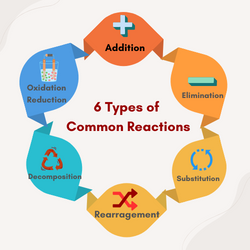
Studying organic chemistry reactions is crucial because it provides a framework for understanding how molecules transform, which is central to mastering the subject. Therefore, to offer structure and clarity, and to recognise patterns, we have created the chapter “Common Reaction Types”, where we classified reactions into six subtypes: addition, elimination, substitution, rearrangement, oxidation-reduction, and decomposition. This structured approach enables you to recognize patterns, predict reaction products and mechanisms, and select appropriate reagents and conditions for both familiar and unfamiliar molecules, ultimately achieving targeted molecular transformations.
Classification of common reactions based on mechanisms
Addition Reactions
Elimination Reactions (E1, E2, E1cb)
Substitutions (SN1, SN2, SNAr, Electrophilic, Nucleophilic)
Decomposition
Rearrangement
Oxidation-Reduction
By mastering these concepts, you’ll build essential problem-solving skills to manipulate chemical transformations effectively, equipping you with a robust mental toolkit to excel in organic chemistry with confidence.