Differences between Electrofuge and Electrophile
Two electron-deficient species on opposite sides of heterolytic cleavage: one departs without the bond pair, the other arrives to form a new bond.
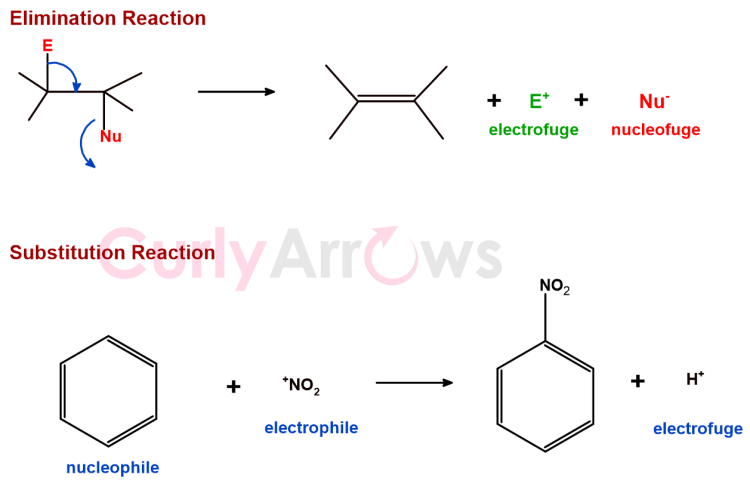
Leaves. A leaving group that departs without the bond pair.
Electron-deficient after departure. Classic example: H+ leaving an aromatic ring during electrophilic substitution.
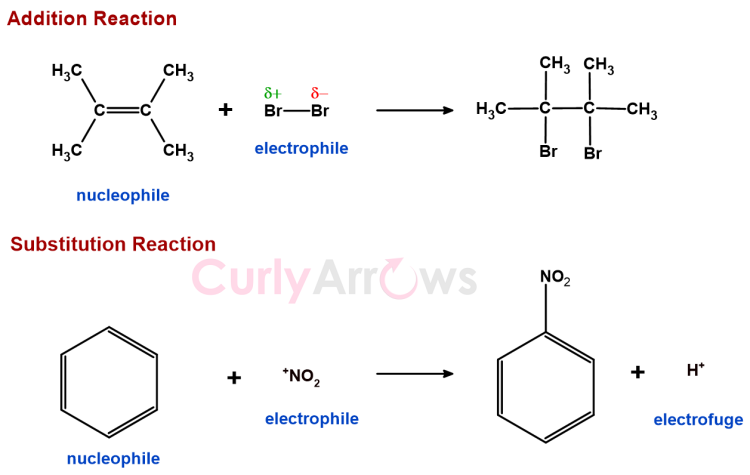
Arrives. An electron-deficient species that accepts electrons to form a bond.
Electron-deficient by nature, either neutral or positively charged. Common examples: H+, CH3+, NO2+, AlCl3.
i. Definition of electrofuge and electrophile
Electrofuge
An electrofuge is a leaving group that is formed due to the heterolytic breakage of a bond, where after the cleavage, it leaves without the bond pair of electrons, and is therefore electron-deficient.
Electrophile
Electrophiles are electron-deficient species, which may be neutral or charged because of heterolytic bond cleavage. Their primary nature is to attract electrons from other electron-rich counterparts and form a new bond.
ii. Role in the reaction, leaving vs arriving
Electrofuge
The departing partner. An electrofuge leaves a substrate. It is what comes off when a new electrophile attaches.
Electrophile
The arriving partner. An electrophile attacks a substrate that is electron-rich. It is what attaches when an electrofuge leaves.
iii. When each becomes electron deficient
Electrofuge
Becomes electron-deficient at the moment of departure. The bond pair stays with the substrate; the electrofuge leaves with no electrons from the broken bond.
Electrophile
Is already electron-deficient before arrival. That is what drives it to seek an electron-pair from a nucleophile or an electron-rich substrate.
iv. Examples of electrofuges and electrophiles
Electrofuge
The classic example is hydrogen as an electrofuge, H+. The loss of hydrogen as H+ is common in aromatic electrophilic substitution, where the incoming electrophile displaces H+ as the leaving group.
Example: in the nitration of benzene, the incoming electrophile is NO2+, and H+ is the electrofuge.
Electrophile
Common electrophiles include both charged and neutral species. Charged: H+, CH3+, NO2+. Neutral but electron-deficient: CH3COCl (acyl chloride), AlCl3 (Lewis acid).
Examples: H+, CH3+, NO2+, CH3COCl, AlCl3.
v. Reactions involving electrofuges and electrophiles
Electrofuge
Electrofuges are formed in elimination and substitution reactions involving electrophiles. Wherever an electrophile bonds to a substrate by displacement, the displaced group is the electrofuge.
Electrophile
Electrophiles participate in addition and substitution reactions alongside nucleophiles, displacing an electrofuge in the substitution case and adding across a multiple bond in the addition case.
vi. Electrofuge and electrophile in aromatic electrophilic substitution
Electrofuge
H+ is released from the aromatic ring after the electrophile has bonded to a ring carbon. This restores the aromatic pi system. The departing H+ is the electrofuge.
Electrophile
NO2+, Br+, R+, RC(=O)+, and SO3 all attach to the aromatic ring at the start of the reaction. Each is the electrophile. The ring's pi electrons attack the electrophile.
Mnemonic: ‘-fuge flees, -phile loves.’ The suffix ‘-fuge’ comes from Latin fugere, to flee (think of how a centrifuge flings things outward). The suffix ‘-phile’ comes from Greek philos, loving. An electro-fuge flees the bond without electrons. An electro-phile loves electrons and forms a new bond to them.
Why this works: Both species are electron deficient, so the suffix is what tells them apart. One is in the leaving direction, the other in the arriving direction.
In the nitration of benzene with HNO3/H2SO4, the NO2+ ion bonds to the ring and an H+ leaves. The H+ that leaves is which species?
Read the full explanation Hide full explanation
How electrofuges and electrophiles work in polar mechanisms
What electrofuges and electrophiles are
Both terms describe electron-deficient species that arise in heterolytic reactions, but they sit on opposite sides of the bond-making event. An electrofuge is what leaves a substrate without the bond pair after heterolytic cleavage; an electrophile is what arrives at a substrate looking for an electron pair to form a new bond [1]. Identifying which species plays which role is one of the basic mechanism-reading skills in organic chemistry.