Ever looked at a cloud formation and wondered at its shapes? Sometimes, it’s Winnie the Pooh, Snoopy the Dog, a dragon, or a man jet skiing. Perhaps the images we spawn are our association with the world we live in and relate to. Maybe it was this association that the scientist who drew the first sawhorse projections tried to analogize when relating the unseen with the seen. We may never know! Still, the Sawhorse projection is said to be similar to a carpenter’s sawhorse or a mule, used to support a plank for sawing.
In chemistry, a sawhorse projection depicts the arrangement of substituents on two adjacent carbon atoms shaped like a sawhorse. And for that, one must first draw the two carbon atoms as a diagonal line. This practice ensures the angle at which the observer looks at the molecule. If the substituents are arranged on a diagonal line, the groups at the left ends look near, and the right ends look away from the observer.
The next attempt is to arrange the group, so the sawhorse has two front and hind feet. The third group may represent the head and the tail.

Now, chemistry is more complex than the apparent world we live in. Organic molecules containing single bonds undergo bond rotations. So, the Y end of the sawhorse projection, due to the bond rotation, may sometimes be shown as inverted. In reality, they represent the eclipsed and staggered conformations.
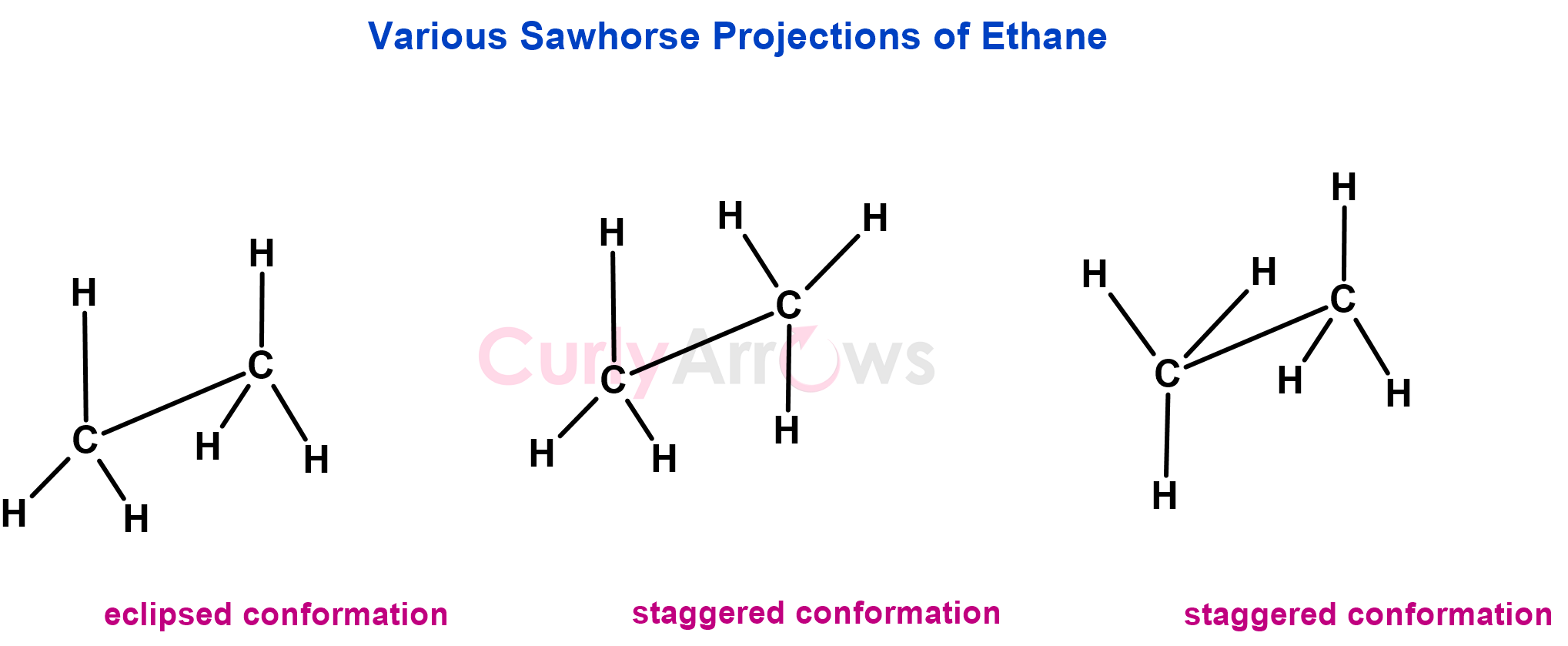
Read all about Conformations from the Chapter Stereochemistry.
Sawhorse projections are a useful tool for understanding conformations in organic molecules. They help visualize the interaction of various substituents that may stabilize or destabilize certain conformations.
If a plane is passed through the projection, cutting it in lengthwise half, it would divide the groups above the plane, in the plane, and below the plane. Such an outlook can help to understand three-dimensionally the arrangement of groups, whether they are facing away or towards an observer.
Read Newman Projections, Chapter Drawing Organic Structures.

Therefore, drawing sawhorse projections can be essential for picturing transitions between representations, studying interactions and reactions, and drawing Newman Projections in organic chemistry.
This is an excerpt from CurlyArrows' Introduction to Organic Chemistry Premium Tutorials, Chapter Drawing Organic Structures. Preview the Book.