Structure of Atom

Introduction to Atoms: The Building Blocks of Matter

Everything around us—every breath we take, every object we touch, every star in the night sky—is built from atoms, the invisible building blocks of matter. These microscopic entities, far too small to see with the naked eye, hold the key to understanding the universe at its most fundamental level. Atoms are more than just scientific curiosities; they are the foundation of chemistry, physics, and biology, governing the interactions that form molecules, materials, and life itself. 
Groups

Groups in chemistry refer to the arrangement of elements of the periodic table into vertical columns. These vertical columns, called groups, are numbered from 1 to 18 and run from top to bottom. The first column on the left is labelled Group 1, and the last column on the right is labelled Group 18. 

The elements in the group have the same number of electrons (valence electrons) in their outermost shell, also known as the valence shell, due to which they all have the same chemical or physical properties.

Periods

Periods in chemistry refer to the horizontal rows of elements in the periodic table, which represent all 118 elements across 7 rows. 

The periods run from left to right, with each consecutive element increasing in atomic number by 1.  

Periods 1, 2, and 3 have 2, 8, and 8 elements, whereas periods 4, 5, 6, and 7 have 18, 18, 32, and 32 elements.


Atom: Unveiling the Invisible


A great experiment to demonstrate the existence of atoms is Brownian motion, originally observed by Robert Brown in 1827. 

Difference Between Valence and Core electrons

Valence Electrons

Core Electrons

Valence Electrons are farthest away from the nucleus at the outermost shell. This increase in the distance from the nucleus weakens the attractive nuclear interactions raising its energies.

The core electrons are the those present closer to the nucleus. Their attractive interactions with the nucleus are stronger, which lowers their energy and contributes to stability.

Valence Electrons

The outermost electrons of an atom that are mostly involved in bonding reactions are called valence electrons. These electrons are farthest from the nucleus and have high energy.

For example, the total number of electrons in Lithium is three distributed in two energy levels, closest to farthest from the nucleus- 1s2 2s1.


Nucleus of an atom

An atom has a central, dense, tightly packed nucleus with a diameter of 10-15 m compared to an atom at 10-10 m, a size equivalent to a marble in a football stadium. Therefore, the nucleus makes up less than 0.01 % of the atom's volume.

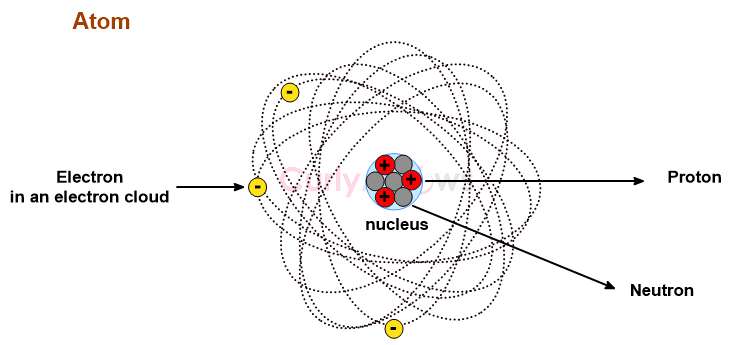
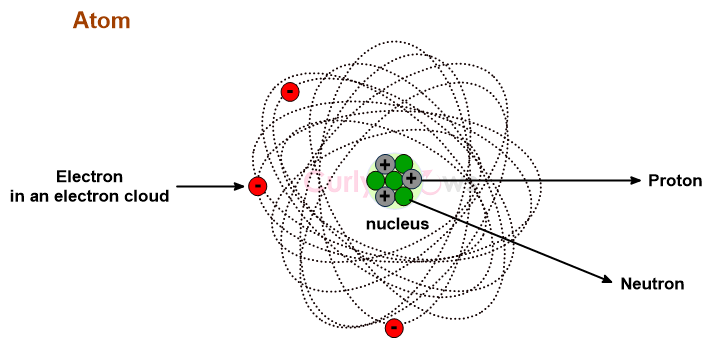
The nucleus contains positively charged protons and neutral neutrons as subatomic particles bound firmly by the nuclear force.

Molecule

A molecule is an electrically neutral chemical entity that consists of two or more bond atoms.

The joining of two or more atoms by a linkage known as a covalent bond creates molecules such that changing the connection, or the arrangement will change the molecule and its properties. 

Atom

The matter is composed of invisible, indivisible, innumerable particles called atoms. Atoms are responsible for giving each matter its unique properties and identity. The uniqueness comes from the nature of the atom and its composition. Atoms are composed of three subatomic particles- electron, neutron, and proton. For example, an Oxygen atom has 8 electrons, 8 protons, and 8 neutrons.

Unified atomic mass unit

The unit used to describe the mass of an atom is the unified atomic mass unit, symbolized as amu or μ.  

The standard used for measuring the mass of an atom is a 12C atom. Carbon-12 (12C) is an isotope of Carbon with 6 protons, 6 neutrons, and 6 electrons.

The unified atomic mass unit is defined as exactly 1/12 th the mass of one Carbon-12 atom.

Mass Number

The mass number is the total count of the number of protons and neutrons present in the nucleus of an atom, denoted as A.

For example, 12C has 6 protons and 6 neutrons; its mass number is 12.

A mass number is always a whole number. The mass number is also known as the atomic mass number or nucleon number.

Atomic Number

The Atomic number (symbol Z) uniquely identifies an element and is equal to the number of protons present in the nucleus of an atom.

For example, atomic number 6 identifies the Carbon atom with 6 protons in its nucleus. An uncharged Carbon atom will also have 6 electrons in the outer nuclear region, equal to its atomic number.

Isotope

Isotopes are a group of atoms belonging to an element with the same atomic number but a different mass number. Such a group of atoms have the same number of protons in their nuclei but differ only in the number of neutrons.

For example, the Oxygen atom has three isotopes – 16O, 17O, and 18O. All three isotopes have 8 protons; however, the number of neutrons is 8 in 16O, 9 in 17O, and 10 in 18O.

Electron

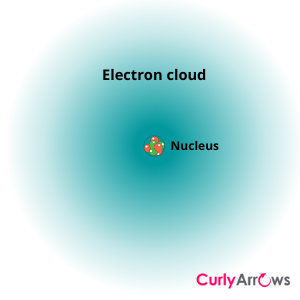
An electron is a negatively charged elementary particle that constitutes an atom, denoted as e- or β-. The electrons are present in the outer-nuclear region of an atom as clouds.