Electronic Displacement in a covalent bond

Permanent Dipole

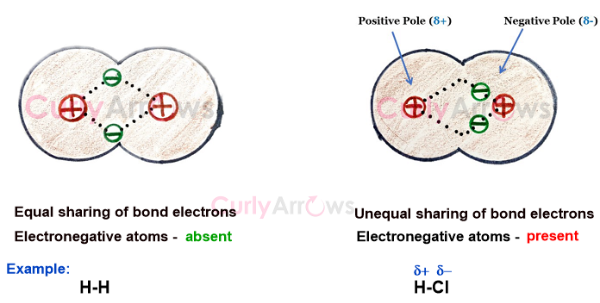
A permanent dipole is an inherent feature of the molecule due to the nature of the participating atoms forming the two-electron covalent bond.

Some atoms withdraw more of the bond electrons towards themselves, increasing their electron density and leaving the other end electron deficient. This unequal electron charge distribution creates positive and negative poles (denoted with δ+, δ- signs), causing the molecule to have permanent poles or a dipole.


Dipole

The redistribution of electrons in an atom, bond, or molecule creates two ends (or poles), one electron-rich negative and the other electron-deficient positive; such an atom, bond, or molecule is said to have a dipole (two poles).


What is the order of the +I effect?

The +I effect is an electron-donating (or an electron-pushing) inductive effect by an atom or group of atoms relative to Hydrogen. It means that a +I group like methyl (-CH3) will push electrons away from itself more than the hydrogen atom would if it occupied the exact position in the molecule.

The push of electrons is represented with an arrow over the bond, (>) indicating the direction of the electron flow.


Electronegativity

Electronegativity measures on a scale of 0.8 – 4 an atom’s or group of atoms’ tendency to attract the bond electron pair towards itself, thereby creating partial negative (δ-) and positive (δ+) terminals.


Inductive Effect

An atom or group of atoms that can pull the bond electrons towards itself or push the bond electrons from itself and decreasingly transmit the effect along the sigma (σ) bonds of the carbon chain inducing permanent polarization in the molecule. Such an effect is called the Inductive effect.


Resonance

Resonance theory explains various observed properties in a molecule using the electron delocalization concept and multiple Lewis structures, which a single Lewis structure cannot.

A single Lewis structure can only describe some but not all of a molecule's observed properties. Resonance theory is helpful in molecules that can be expressed using several Lewis structures, like Benzene or CO2

What is Electronegativity?

Sharing resources is essential to build a harmonious world. When the resources are shared ineffectively conflicts emerges. A similar principle extends to Chemistry. 

Atoms are in a state of harmony when the neighbouring atoms shares electrons. When the sharing stops, Chemical reactions triggers.

The imbalance in sharing electrons influences the molecule’s polarity, reactivity, and physical properties. The disagreement on sharing is brought about by electronegativity.