Drawing Organic Structures

Molecular Formula

A molecular formula expresses in positive whole numbers the total count of each atom in a molecule. 

For example, in the molecular formula of H2O, the total count of Hydrogen atoms is 2, and that of Oxygen atoms is 1. Another example of a complex molecule, such as glucose, expressed in a molecular formula as C6H12O6, has a total of 6 carbon and oxygen atoms, and 12 hydrogen atoms.

A molecular formula is always a multiple of the empirical formula, and their relationship is expressed as,
Structural Formulas

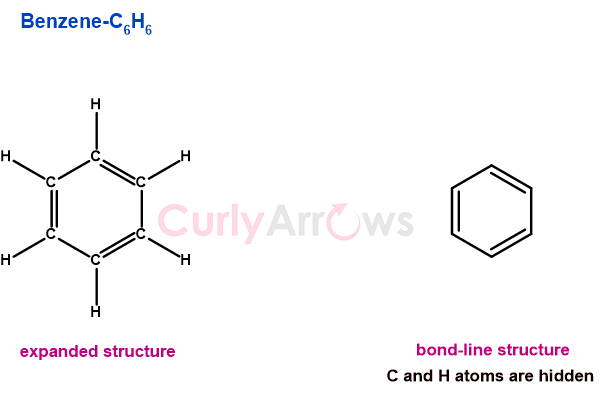
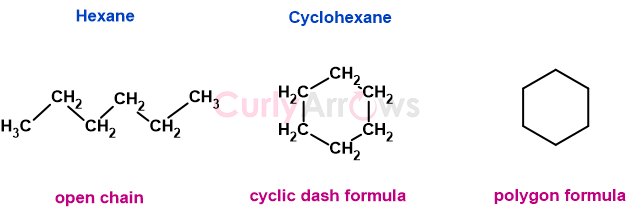
Structural formulas are used to display covalently bonded molecules in the order they are bonded. The atoms may bond using single, double, or triple bonds. Some structural formulas show only the atoms without displaying the complete structure with bond angles and, in some cases, even the bonds.

Newman Projection

Newman Projection is a way of representing the spatial relationship of groups attached to two adjacent carbon atoms in a molecule. The angle at which the observer makes this observation occurs when they try to visualize the molecule head-on along the bond axis joining the two atoms, such that one carbon atom is seen as a front and the other as a rear.

Sawhorse Projection

It is a way of visualizing the carbon atoms of an open-chain organic molecule from an oblique angle and projecting that image on a 2-dimensional paper to appear like a carpenter’s sawhorse. 

The two adjacent carbons of interest in a chain are drawn as a slant line, and its two groups form the hind and forelegs, with the third forming the head and the tail to resemble a horse from which the name draws an inspiration.


Sawhorse Projection

Ever looked at a cloud formation and wondered at its shapes? Sometimes, it’s Winnie the Pooh, Snoopy the Dog, a dragon, or a man jet skiing. Perhaps the images we spawn are our association with the world we live in and relate to. Maybe it was this association that the scientist who drew the first sawhorse projections tried to analogize when relating the unseen with the seen. We may never know! Still, the Sawhorse projection is said to be similar to a carpenter’s sawhorse or a mule, used to support a plank for sawing.

Isomers and Isomerism

Isomers are molecules with the same molecular formula; that is, they have the same atoms in exact numbers (or the same molar masses); however, they still differ in their structures.  

These differences or structural variations arise due to the atom’s attachment styles. 

An atom may connect differently, each time having different set of neighbors by bond or in space. 

Differentiating complete structural formulas and condensed structural formulas using examples

Draw complete structural formulas and  condensed structural formulas for

        a) three compounds of formula C3H8O

        b) five compounds of formula C3H6O

The condensed structural formula disguises the molecule's true vastness by revealing only the number of atoms present. What remains hidden from sight are the bond connections, the bond angles, and their three-dimensional arrangements, so what we observe is just the molecule's literal condensed form.

Differences between Molecular Formula and Empirical Formula


Empirical Formula

Molecular Formula

Essence

The empirical formula is the first primitive information available to identify the kind of atom of various elements present in one molecule of a chemical compound without revealing their exact numbers.

Once the empirical formula identifies the atoms present, their exact number is disclosed using the molecular formula. 

Drawing Organic Structures- Lewis Structures

The first time the use of two dots or a colon (:) to represent two electrons acting as connecting links between the two atoms was proposed by G.N. Lewis in 1916.

In his landmark paper, ‘the atom and the molecules,’ he attempted to draw molecular structures using dots to represent the covalent nature of the chemical bonds, now popularly known as the Lewis structures.

So, a molecule of Cl2 was Cl : Cl, two electrons connecting two Cl atoms.

Molecular models for organic structure representation

Molecular models are tools used for classroom or research to visualize better and interpret three-dimensional structures of organic molecules. The toolkit can be made of wood, plastic, metal, or other materials.

These models are digitally represented using computer graphics covered under molecular modelling, a branch of chemistry that uses computational and theoretical methods to model and mimic the molecule's behaviour in chemical and biological environments.

Bond Line or Skeletal Formula

What is a Bond-Line or Skeletal Formula?

Carbon and Hydrogen containing bonds are chemically inert; still, they form the backbone of many organic compounds. They provide a skeletal framework that can contain other heteroatoms or functional groups. 

Such a carbon-hydrogen-containing chain of compounds together with other atoms or groups of atoms are conveniently represented using zig-zag lines, called the bond-line or skeletal formula.

Condensed Structural Formula- How to write

What is a Condensed Structural Formula?

The condensed structural formula provides the shortest way to understand the atoms and their numbers, their connection with respect to each other, and therefore, visualize the compounds' structure without elaborately drawing it, but by writing it in a single line.

So, if the elaborate structure of butanoic acid look like A, the condensed structural formula would look like B.

Lewis Structures

Of all the electrons that form part of an atom, the valence electrons are the only ones that participate when atoms combine to form a bond. In ionic bonding, electrons are transferred (either lost or gained), whereas in covalent bonding, two electrons are shared between the two atoms. Double or triple bonds are formed when atoms share more than one electron pair. The atoms do so to attain the stable octet configuration of 8 electrons in their valence shell.

How to represent molecules using Lewis dot structures? (With Examples)

The Lewis dot structures are used to show the shared electron pairs between the bonded atoms in the molecule and the lone pairs of electrons if any. The representative structures follow the octet rule wherein the atoms combine by either transfer of electrons (loss or gain) or by sharing of valence electrons in a way that the valence shell of the atoms attains the octet configuration.

The electrons involved are shown as dots. A single bond is made up of two electrons, a double four and a triple bond six. Similarly, an atom can have one, two or three lone pairs of electrons.