Molecules are what you get when atoms decide that being lonely and only one isn't cool. That's when, instead of floating around solo, atoms reach out, share their electrons, and lock together into a brand-new "molecule" with its own shape, smell, taste, and personality.
So, in chemistry, a molecule is a group of two or more atoms held together by covalent bonds, behaving as a single unit of a substance.
Water, sugar, oxygen, the carbon dioxide fizzing in your soda, they are all molecules, or you can say, just atoms holding hands.
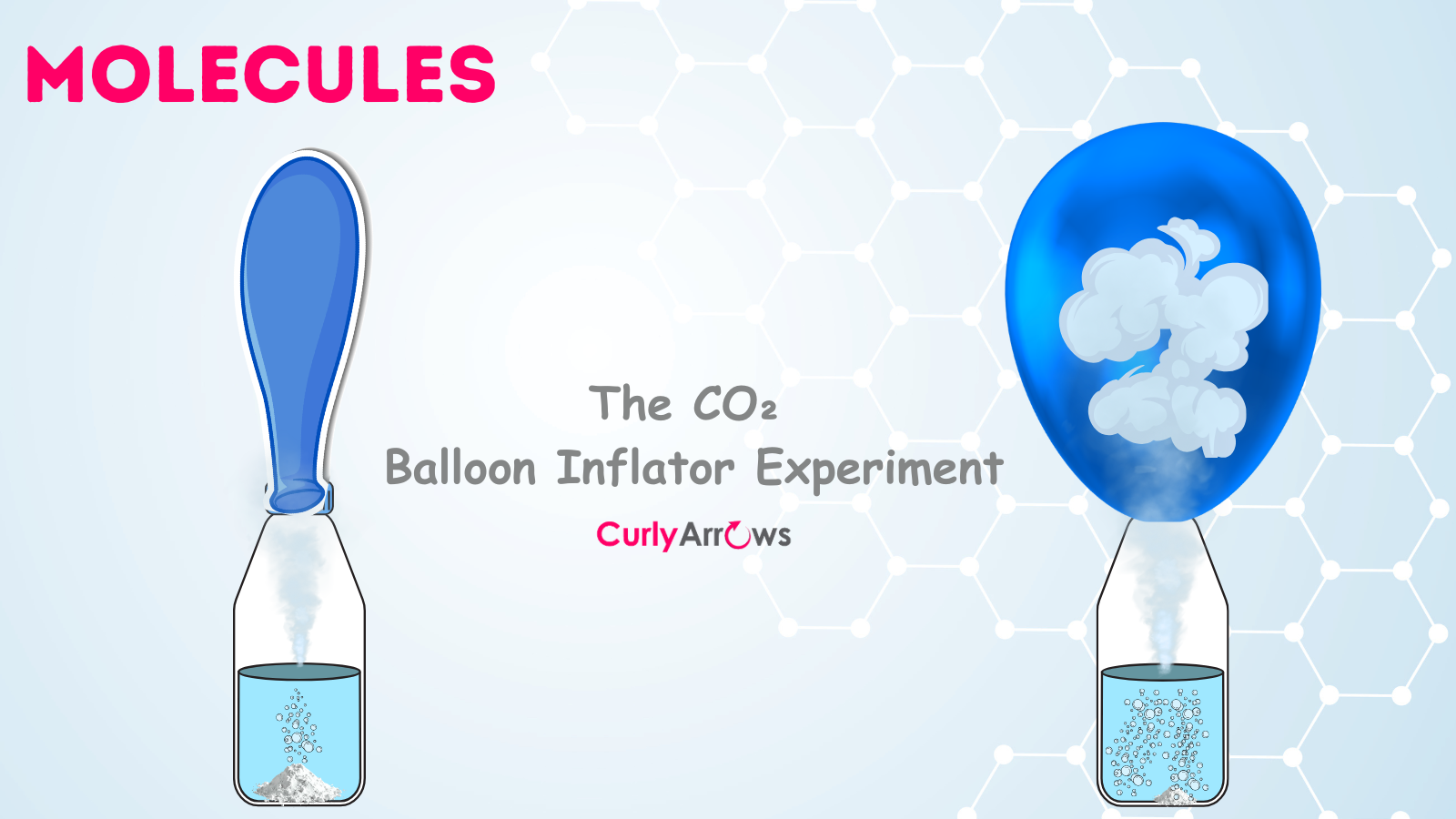
Below is a super simple experiment to capture an invisible molecule (CO₂) in a balloon.
The CO₂ Balloon Inflator Experiment
This kitchen experiment uses baking soda and vinegar to create real carbon dioxide molecules and traps them inside a balloon so you can see molecules at work without ever seeing the molecules themselves.
Materials Needed for the Balloon Experiment
An empty plastic bottle
A balloon
Baking soda (sodium bicarbonate)
Vinegar
A funnel (or rolled paper cone)
Step-by-Step Procedure
Pour about 100 ml of vinegar into the bottle.
Use the funnel to spoon 2 tablespoons of baking soda into the deflated balloon.
Stretch the balloon mouth over the bottle, keeping the baking soda inside the balloon (don't let it drop in yet).
When ready, lift the balloon upright so the baking soda falls into the vinegar.
Watch the balloon.
Observation — What You Should See
The balloon inflates on its own, without anyone blowing into it.
Why It Works — The Chemistry Behind the Balloon
The Reaction Between Baking Soda and Vinegar
When baking soda meets vinegar, their atoms rearrange themselves into brand-new molecules. One of those new molecules is carbon dioxide (CO₂), which consists of one carbon atom bonded to two oxygen atoms.
How CO₂ Molecules Inflate the Balloon
The CO₂ molecules, as a gas, can't fit in the bottle, so they rush upward and fill the balloon. You can't see CO₂ gas, but you can see the balloon inflating, which proves the molecules are real and taking up space. This is the same molecule that fizzes in your soda and that you breathe out every few seconds.
Bonus Variation — Make a Bigger Balloon
Try varying the amount of baking soda. More baking soda = more CO₂ molecules = bigger balloon. There's a limit, though. Once you run out of vinegar molecules to react with, the inflation stops.
Frequently Asked Questions About the CO₂ Balloon Experiment
Why does the balloon stop inflating?
The balloon stops growing once one of the two reactants runs out which is usually the vinegar. Every CO₂ molecule needs both baking soda and vinegar to form, so when the vinegar molecules are all used up, no more CO₂ can be made and the balloon's growth stops. Adding more vinegar mid-experiment will restart the reaction.
Can I use lemon juice instead of vinegar?
Yes. Lemon juice contains citric acid, which reacts with baking soda the same way the acetic acid in vinegar does by producing CO₂ molecules. The reaction is usually a bit slower because lemon juice is weaker than vinegar, but the balloon will still inflate. This is a good way to compare two different acid molecules with different strengths in the same experiment.
Is the gas inside the balloon safe?
Yes. The gas is carbon dioxide (CO₂), the exact same molecule you exhale with every breath and the same one that makes soda fizzy. It is not flammable and not toxic in small kitchen amounts. Just don't breathe directly from the balloon and run the experiment in a well-ventilated room as a normal precaution.
What happens if I use more baking soda?
More baking soda only makes a bigger balloon if there is also enough vinegar to react with it. Once the vinegar molecules are used up, extra baking soda just sits at the bottom doing nothing. Chemists call this the "limiting reactant" — the ingredient that runs out first sets the size of the balloon.