
Organic Chemistry

What is an Electrode Potential?

An electrode when in contact with an electrolyte solution of the similar ionic nature (Example, Cu electrode in CuSO4 solution, Zn electrode in ZnSO4 solution) tends to either undergo Oxidation (loss of electrons) or reduction (gain of electrons).

Due to this oxidation or reduction, there develops a charge separation between the metal electrode and its ions in the solution creating a potential difference.
Electronegativity

Electronegativity measures on a scale of 0.8 – 4 an atom’s or group of atoms’ tendency to attract the bond electron pair towards itself, thereby creating partial negative (δ-) and positive (δ+) terminals.


Acyl

An acyl group is a general way of referring to an R’-C=O unit that forms the core of compounds like aldehydes, ketones, carboxylic acids, and acyl halides in modern organic chemistry.

This acyl group is easily identifiable with its carbon atom that is double-bonded to oxygen (C=O, carbonyl carbon) with one bond to an R’ group, which can be an alkyl or aryl group. 

Differences between Valence Bond Theory (VBT) and Molecular Orbital Theory (MOT)

Aspect

Valence Bond Theory (VBT)

Molecular Orbital Theory (MOT)

Basic Concept

Describes chemical bonding as the overlap of atomic orbitals, forming localized bonds.

Describes bonding by combining atomic orbitals into molecular orbitals that are delocalized over the molecule.

Bonding Explanation

Focuses on bonds as being localized between two specific atoms.

Homolytic Cleavage

Homolytic cleavage, or homolysis, is a chemical reaction in which a covalent bond between two atoms is broken equally, and each atom retains one of the two electrons that form the bond. This creates two species (similar or dissimilar), each with an unpaired electron, known as the radicals. The radical electron is denoted with a dot (.) over the atoms’ symbol.

How to determine the hybridization of C in CH4?

If only valence shells participate in bonding reactions, then Carbon should only form two bonds using its two unpaired electrons. However, Carbon forms four bonds, as seen in CH4, CH3X, H2C=O, and O=C=O molecules. This discrepancy between the number of valence electrons of an atom and the number of bonds it forms (valency) is explained by the hybridization concept, an extension of the Valence Bond (VB) Theory.

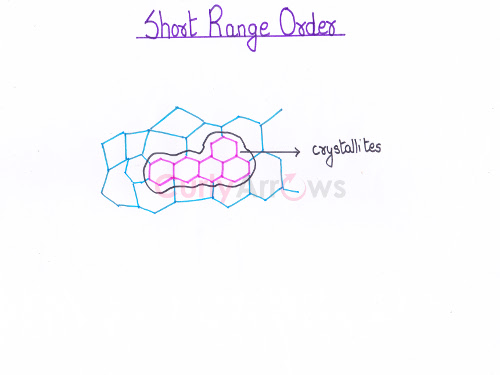
Short Range Order

The regular periodic arrangement of the constituent particles at the lattice points of the unit cell is observed only in a short region. Most liquids and amorphous solids show short range order.