
Alkenes

Zaitsev’s Rule

A rule stating that an elimination reaction will give as the major product the most stable alkene, that is, the alkene with the most highly substituted double bond.

For example, dehydrohalogenation of alkyl halide 2-Bromo-2-methylbutane can proceed in two ways to give two types of alkenes, of which only one is a major product.
 

Which side of an unsymmetrical alkene does the reagent attack and why?

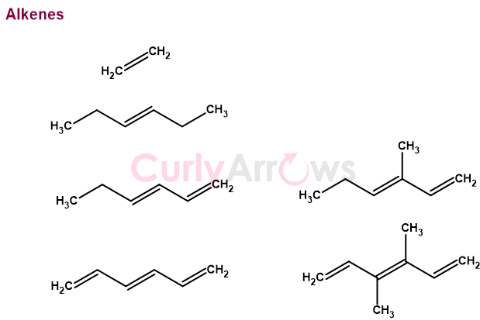
Alkenes are double bonds containing molecules. These double bonds are called pie bonds and are made up of two electrons. Due to the presence of the pie electron cloud, alkenes are electron-rich species and interact with electron-deficient species, the electrophiles. The reaction between alkenes and the electrophiles is an addition reaction.