Filling of atomic orbitals and writing electronic configuration
Learning Objective: To study how the atomic orbitals of an atom are filled, and how the electronic configuration of an atom is written.
Skill Level – Intermediate
Prerequisites:
Learning Objective: To study how the atomic orbitals of an atom are filled, and how the electronic configuration of an atom is written.
Skill Level – Intermediate
Prerequisites:
Commonly, it is accepted that a compound is an Arrhenius acid if it liberates hydrogen ions as H+ in water. In the next step, these H+ ions combine with water molecules to form hydronium ions (H3O+). The two steps can be summarised to say that Arrhenius acids are compounds that form hydronium ions, provided water is the solvent.
When an atom is surrounded by six substituents, arranged in a manner that four are in one plane, one above and below, and their vertices join to give eight faces (octa-hedrons), such a molecular geometry is octahedral.
Since it looks like two pyramids projecting out from a square base, the geometry is also called square bipyramidal.
Stereoisomers are molecules that have the same molecular formula and bonding arrangement; however, they differ in how their atoms are positioned in 3-dimensional space (spatial orientation) with respect to each other.
These molecules, which differ in orientation while still having the same molecular formula, are also known as spatial isomers.
Learning Objective: Study Vander Waals London forces, interactions, and strength.
Skill Level – Intermediate
Prerequisites:
Learning Objective: To learn through an example how a reaction outcome depends on the conformation of the reactant.
Skill Level - Intermediate
Prerequisites:
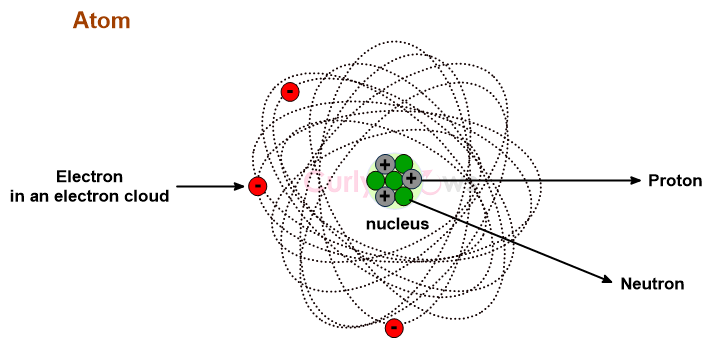
A Neutron is an uncharged, neutral subatomic particle found in an atom's nucleus, denoted as n or n0.
The electrochemical series or the activity series is the arrangement of various electrodes in the increasing order of their standard reduction potential. The reduction potential values are seen to increase from negative to zero and positive real numbers. When arranged linearly, it would look like a number line with the positive numbers on the right side of zero and the negative numbers on the left side of zero.