
Organic Chemistry

Molecular models for organic structure representation

Molecular models are tools used for classroom or research to visualize better and interpret three-dimensional structures of organic molecules. The toolkit can be made of wood, plastic, metal, or other materials.

These models are digitally represented using computer graphics covered under molecular modelling, a branch of chemistry that uses computational and theoretical methods to model and mimic the molecule's behaviour in chemical and biological environments.

Electronegativity

Electronegativity measures on a scale of 0.8 – 4 an atom’s or group of atoms’ tendency to attract the bond electron pair towards itself, thereby creating partial negative (δ-) and positive (δ+) terminals.


Difference between Qualitative and Quantitative Analysis in Organic Chemistry


Qualitative Analysis

Quantitative analysis

Aim

Identifies what compounds or functional groups are present. Therefore, the type of information obtained is descriptive.

For example, whether the compound changed color, evolved gas, or formed a precipitate. 


Measures how much of a compound is present and, therefore, numerically describes its quantity. 

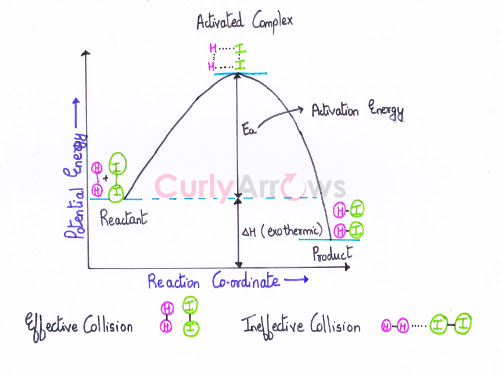
Effective Collisions

Effective collisions result in product formation due to an increase in the rate of a chemical reaction. It occurs when the two reactant molecules are correctly oriented and have attained the threshold value (or the activation energy value) at the time of the collision.