Filling of atomic orbitals and writing electronic configuration
Learning Objective: To study how the atomic orbitals of an atom are filled, and how the electronic configuration of an atom is written.
Skill Level – Intermediate
Prerequisites:
Learning Objective: To study how the atomic orbitals of an atom are filled, and how the electronic configuration of an atom is written.
Skill Level – Intermediate
Prerequisites:
Learning Objective: To learn about various methods by which a carbanion reacts with other positive centers in organic chemical reactions.
Skill Level - Advanced
Prerequisites:
Dalton, in 1804, in his work on ‘Atomic Theory,’ proposed the law of chemical combination to explain how atoms form compounds. According to him, atoms of different elements combine in a simple whole-number ratio to give compounds.
For example, two Hydrogen and one Oxygen combine to form water (H2O), or four Hydrogens and one Carbon combine to form methane (CH4), or one Nitrogen combines with three Hydrogens to give ammonia (NH3).

Learning Objective: To learn about the structure, type, and nature of the carbanion intermediate part of organic chemistry reactions.
Skill Level - Intermediate
Prerequisites:
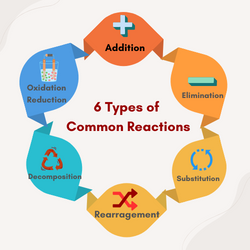
Identifying a change is the first step in solving or designing a chemical reaction.
Learning Objective: To study the three types of addition reactions that nucleophiles undergo.
Skill Level - Intermediate
Prerequisites:
Anion | Cation |
|---|---|
A negatively charged ion is an anion. Examples: Cl-, O-2 | A positively charged ion is a cation. Examples: Li+, Mg+2 |
A neutral atom's gain of electron(s) forms an anion (reduction reaction). |
Inorganic chemistry describes oxidation in two ways. The first method is through the loss of electrons, and the second is by the increase in oxidation number.
Structural Isomerism | Stereoisomerism |
|---|---|
Isomers have the same molecular formula but differ in how the atoms are bonded to each other. | Isomers have the same molecular formula and bonding arrangement; however, they differ in how the atoms are arranged in 3-dimensional space (spatial orientation) with respect to each other. |
Such molecules that differ by bonds while still having the same molecular formula are also known as constitutional isomers. |