
Organic Chemistry

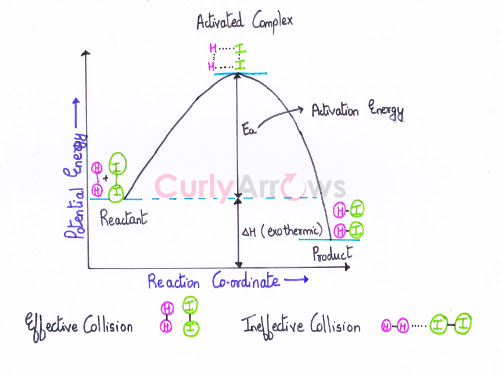
Effective Collisions

Effective collisions result in product formation due to an increase in the rate of a chemical reaction. It occurs when the two reactant molecules are correctly oriented and have attained the threshold value (or the activation energy value) at the time of the collision.
 

Brownian Motion

The random collisions of the colloidal particles (dispersed phase) with molecules of the dispersion medium (colloidal sol) that results in a zig-zag movement of the colloidal particles, when observed under an ultramicroscope, is known as the Brownian Motion.


Octahedral Geometry

When an atom is surrounded by six substituents, arranged in a manner that four are in one plane, one above and below, and their vertices join to give eight faces (octa-hedrons), such a molecular geometry is octahedral.

Since it looks like two pyramids projecting out from a square base, the geometry is also called square bipyramidal.


Peptization

The process of transforming a freshly prepared precipitate to a colloidal sol by shaking it with a small amount of electrolyte having an ion common to the precipitate, in a dispersion medium is known as the peptization, and the electrolyte used for such a purpose is called the peptization agent.


Nucleophiles

Nucleophiles are an atom or a group of atoms that are richer by two electrons and donate these electrons to electron-deficient species, the electrophiles.

Donating the electrons from the nucleophile to the electrophile creates a new two-electron covalent bond.