Bonding in Atoms
Atoms primarily form three types of bonds – ionic, covalent, and metallic.
We start by exploring the Octet Rule that determines Ionic and Covalent bonds.
Atoms primarily form three types of bonds – ionic, covalent, and metallic.
We start by exploring the Octet Rule that determines Ionic and Covalent bonds.
Learning Objective: To learn about the components of an atom and the importance of proton numbers.
Skill Level – Intermediate
Prerequisites:
The Lewis dot structures are used to show the shared electron pairs between the bonded atoms in the molecule and the lone pairs of electrons if any. The representative structures follow the octet rule wherein the atoms combine by either transfer of electrons (loss or gain) or by sharing of valence electrons in a way that the valence shell of the atoms attains the octet configuration.
The electrons involved are shown as dots. A single bond is made up of two electrons, a double four and a triple bond six. Similarly, an atom can have one, two or three lone pairs of electrons.
Learning Objective: To study the various stabilizing and destabilizing interactions affecting the stability of conformations.
Skill Level - Intermediate
Prerequisites:
All atoms and molecules show London Dispersion Force, a primary way atoms and molecules interact. Most of the time, molecules have additional stronger forces than the London Dispersion Force, which is the weakest. Therefore, London Dispersion forces are exclusively seen in the nonpolar molecules since they don't have other competing functional groups leading to other interfering intermolecular interactions.
The Average Atomic mass of an element is the weighted average of the atomic masses of all naturally occurring isotopes of an element. It is also known as the atomic weight and is expressed in amu.
The weighted average gives a more accurate value than the normal average by considering all isotopic forms of an element.
Periods in chemistry refer to the horizontal rows of elements in the periodic table, which represent all 118 elements across 7 rows.
The periods run from left to right, with each consecutive element increasing in atomic number by 1.
Periods 1, 2, and 3 have 2, 8, and 8 elements, whereas periods 4, 5, 6, and 7 have 18, 18, 32, and 32 elements.
Intermolecular forces are collective forces in organic chemistry that cause atoms and molecules to stick together and interact; therefore, they are electrostatic in nature. The collective strength of these electrostatic interactions can affect a compound's physical properties, like melting and boiling points, density, refractive index, solubility, and others.
Almost all atoms and molecules interact through intermolecular forces, an inherent property resulting from the presence of electrons.
Full Charges | Partial Charges | Transient Charges |
|---|---|---|
Atoms attain full charges (+ or -) by losing or gaining electrons and forming ions. So, a full charge on an ion is equivalent to the charge of a proton (in case of electron loss) or an electron (in case of electron gain).
|
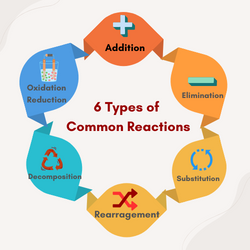
Identifying a change is the first step in solving or designing a chemical reaction.