Organic Chemistry

Unified atomic mass unit

The unit used to describe the mass of an atom is the unified atomic mass unit, symbolized as amu or μ.  

The standard used for measuring the mass of an atom is a 12C atom. Carbon-12 (12C) is an isotope of Carbon with 6 protons, 6 neutrons, and 6 electrons.

The unified atomic mass unit is defined as exactly 1/12 th the mass of one Carbon-12 atom.
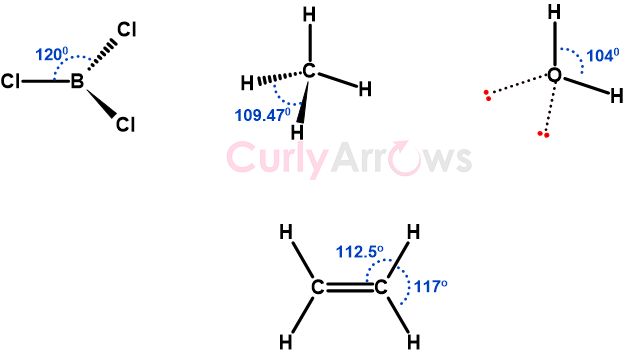
Bond Angle

A bond angle is a geometrical angle between two bonds originating from the same central atom in a covalently bonded molecule, measured in degrees (o).
 

Bond angle definition


Permanent Dipole

A permanent dipole is an inherent feature of the molecule due to the nature of the participating atoms forming the two-electron covalent bond.

Some atoms withdraw more of the bond electrons towards themselves, increasing their electron density and leaving the other end electron deficient. This unequal electron charge distribution creates positive and negative poles (denoted with δ+, δ- signs), causing the molecule to have permanent poles or a dipole.


Bond Line or Skeletal Formula

What is a Bond-Line or Skeletal Formula?

Carbon and Hydrogen containing bonds are chemically inert; still, they form the backbone of many organic compounds. They provide a skeletal framework that can contain other heteroatoms or functional groups. 

Such a carbon-hydrogen-containing chain of compounds together with other atoms or groups of atoms are conveniently represented using zig-zag lines, called the bond-line or skeletal formula.

Difference Between Valence and Core electrons

Valence Electrons

Core Electrons

Valence Electrons are farthest away from the nucleus at the outermost shell. This increase in the distance from the nucleus weakens the attractive nuclear interactions raising its energies.

The core electrons are the those present closer to the nucleus. Their attractive interactions with the nucleus are stronger, which lowers their energy and contributes to stability.

Sawhorse Projection

Ever looked at a cloud formation and wondered at its shapes? Sometimes, it’s Winnie the Pooh, Snoopy the Dog, a dragon, or a man jet skiing. Perhaps the images we spawn are our association with the world we live in and relate to. Maybe it was this association that the scientist who drew the first sawhorse projections tried to analogize when relating the unseen with the seen. We may never know! Still, the Sawhorse projection is said to be similar to a carpenter’s sawhorse or a mule, used to support a plank for sawing.

Mass Number

The mass number is the total count of the number of protons and neutrons present in the nucleus of an atom, denoted as A.

For example, 12C has 6 protons and 6 neutrons; its mass number is 12.

A mass number is always a whole number. The mass number is also known as the atomic mass number or nucleon number.