Organic Chemistry Tutorials

Types of Arrows used in Chemistry

A comprehensive list of 18 types of the arrows frequently encountered in chemistry with examples - Chemical Reaction Arrow, Reversible Reaction Arrow, Equilibrium Reaction Arrow, Double Headed Curly Arrow, Fishhook Curly Arrow, Dashed Arrow, The Crossed or The Broken Arrow, Resonance Arrow, Retrosynthesis Arrow, Rearrangement Reaction arrow, Reflux Reaction Arrow, Orbital Electrons Arrow, Co-ordinate Covalent Bond Arrow, Upward Arrow (Gas Evolution), Downward Arrow (Precipitate), Clockwise and Anti-Clockwise/ Stereochemical Arrow, Wavy Arrow, and Dipole Moment Arrow.

What is Degree/Level of Unsaturation (LU) or Double Bond Equivalent (DBE)? How to find and interpret DBE values?

The DBE calculation uses the general molecular formula to find the presence of unsaturation in a compound. The unsaturation is calculated in levels or degrees. 

The lowest degree of unsaturation (DOU) indicates minimum unsaturation, where there is the least loss of hydrogens to form a pie bond or a cyclic ring, like in cycloalkanes.


General Molecular Formula

What are haloalkanes and haloarenes? How can they be classified?

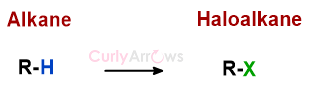
A Haloalkane is the Halogen derivative of an alkane obtained by replacing of one or more hydrogen atoms.

For example, when one Hydrogen of an alkane, Methane, is replaced with a Halogen, for instance, Chlorine, the haloalkane obtained is chloromethane.

                                                               Alkane                 Haloalkane

Difference Between Phenol, Phenyl, Benzene, Benzyl, and Aryl

It is easy to identify the simplest aromatic hydrocarbon Benzene that is made of only two atoms- Carbon and hydrogen. Benzene is a planar, cyclic ring molecule with six sides. It has an alternating double bond that contributes to its extra stability by endowing it with resonance, a phenomenon of electron delocalization.  The molecular formula of Benzene is C6H6 and the structure is-