Benzyl
A benzyl, abbreviated as Bn, refers to the phenylmethyl group (C6H5-CH2-), consisting of a benzene ring attached to a methylene (-CH2-) group.
A benzyl, abbreviated as Bn, refers to the phenylmethyl group (C6H5-CH2-), consisting of a benzene ring attached to a methylene (-CH2-) group.
Lone pair is a set of electrons present in an atom’s valence shell that did not participate in any bond-formation reaction. Since they refuse to bond with the other atoms, they are also called the non-bonding electrons. While drawing the molecules’ structure, the lone pair electrons on shown as dots (..) above the atom.
A sp3 hybridized carbon is a tetravalent carbon that forms four single covalent bonds with itself or atoms of other p-block elements to its right, namely Oxygen, Carbon, Nitrogen, and Halogens. It also forms a bond with elements capable of forming covalent bonds, such as hydrogen.
The bonds formed are of equal strength and at an angle of 109.5o due to which the central carbon atom is tetrahedral in shape. Example, carbon of an alkane or an alkyl group.
Ion Dipole | Ion Induced Dipole |
|---|---|
Ion-Dipole interactions occur due to the electrostatic attraction between charged ions and the dipoles of the polar molecules. | The charged ions induce temporary dipole formation in otherwise nonpolar molecules to attract electrostatically, causing ion-induced dipole interactions. |
Newman Projection is a way of representing the spatial relationship of groups attached to two adjacent carbon atoms in a molecule. The angle at which the observer makes this observation occurs when they try to visualize the molecule head-on along the bond axis joining the two atoms, such that one carbon atom is seen as a front and the other as a rear.
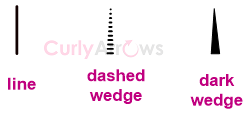
Certain conventions are used to represent three-dimensional structures of organic molecules on paper. Using simple lines, solid (dark), and dashed wedges, a 3D image of a molecule can be perceived on two-dimensional paper.
Everything around us—every breath we take, every object we touch, every star in the night sky—is built from atoms, the invisible building blocks of matter. These microscopic entities, far too small to see with the naked eye, hold the key to understanding the universe at its most fundamental level. Atoms are more than just scientific curiosities; they are the foundation of chemistry, physics, and biology, governing the interactions that form molecules, materials, and life itself.
Water at room temperature is liquid in nature due to the hydrogen bonds holding the water molecules (H2O). The close association is hard to break; therefore, water boils at a high temperature of 100oC. The high temperature breaks the Hydrogen bond links to free individual H2O molecules.
In substitution reactions, an atom or group of atoms is displaced and replaced by another atom or group of atoms. The displaced atom is called the leaving group. The rest of the molecule remains unaffected.