Atom
Atoms are the starting point for studying organic chemistry. In our Chapter, we start by introducing the structure and components of an atom, covering protons, neutrons, and electrons.
Atoms are the starting point for studying organic chemistry. In our Chapter, we start by introducing the structure and components of an atom, covering protons, neutrons, and electrons.
Atoms primarily form three types of bonds – ionic, covalent, and metallic.
We start by exploring the Octet Rule that determines Ionic and Covalent bonds.
The chapter goes into an in-depth breakdown of popular theories explaining bond formation, covering the Valence Bond Theory, Hybridization, and Geometry & Shape of Molecules in VSEPR theory.
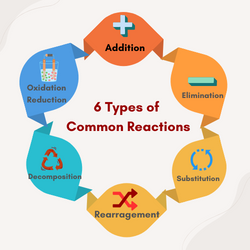
Identifying a change is the first step in solving or designing a chemical reaction.
Drawing molecules every time may be tedious, time and space-consuming. So, you must understand how to use short-hand methods to represent organic structures.
Structural isomerism is the variations in structures between two or more molecules having the same molecular formula.
Intermolecular forces are responsible for holding various molecules and ions close to each other. Their attractive strength is significant enough to affect various physical, chemical, and biological properties.
A good movie stirs emotions in us. Dramatized by fine actors, the motion picture delivers a story, communicates ideas, invokes feelings, displays beauty, and sometimes hopes to change our perception.
A chemical reaction always begins with a reactant (starting material) and to, which, when a suitable reagent is added, triggers a chemical response.