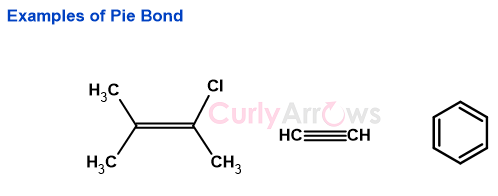
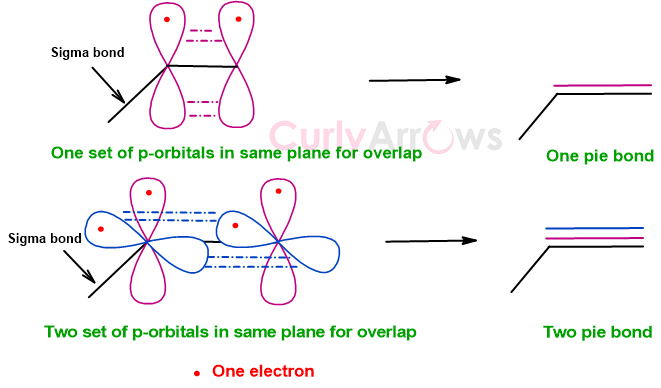
Once the sigma bonds are formed, any additional electrons in the perpendicular unhybridized p-atomic orbitals engage in side-to-side or lateral overlap to form an additional bond known as the pi bond. The symbol π denotes the pi bond, drawn as an additional line over the sigma bond in the molecular structure.
The engagement of two electrons from two p-orbitals of each atom forms one pi bond, resulting in a double bond (=). Similarly, the overlap of two more electrons from additional p-orbitals gives two pi bonds, and with the previous sigma bond, a triple bond (≡) is formed.
As the pi bond holds two atoms in additional orbital overlap, bridging their distance and reducing the bond length, their bond rotation is also restricted.
The pi bond is weaker than the sigma bond since the electron densities are diffused and placed on either side of the internuclear axis resulting in a less efficient overlap. Due to this, it’s easier to break a pi bond than a sigma bond.
Examples-