
P

Periods

Periods in chemistry refer to the horizontal rows of elements in the periodic table, which represent all 118 elements across 7 rows. 

The periods run from left to right, with each consecutive element increasing in atomic number by 1.  

Periods 1, 2, and 3 have 2, 8, and 8 elements, whereas periods 4, 5, 6, and 7 have 18, 18, 32, and 32 elements.
 

Pi bond

Once the sigma bonds are formed, any additional electrons in the perpendicular unhybridized p-atomic orbitals engage in side-to-side or lateral overlap to form an additional bond known as the pi bond. The symbol π denotes the pi bond, drawn as an additional line over the sigma bond in the molecular structure.

Permanent Dipole

A permanent dipole is an inherent feature of the molecule due to the nature of the participating atoms forming the two-electron covalent bond.

Some atoms withdraw more of the bond electrons towards themselves, increasing their electron density and leaving the other end electron deficient. This unequal electron charge distribution creates positive and negative poles (denoted with δ+, δ- signs), causing the molecule to have permanent poles or a dipole.


Physical Properties

Physical properties identify the substance's unique nature by subjecting the substance to qualitative and quantitative measurements. In these experiments, the substance does not undergo destruction or reconstitution of its composition but can change states/phases. 

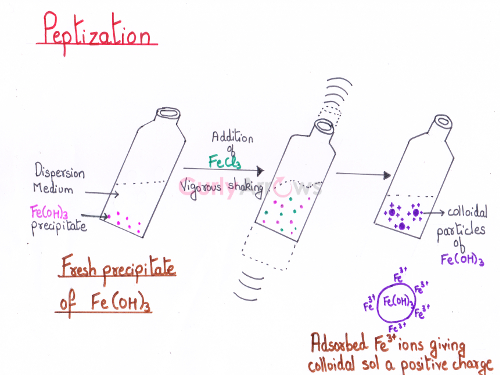
Peptization

The process of transforming a freshly prepared precipitate to a colloidal sol by shaking it with a small amount of electrolyte having an ion common to the precipitate, in a dispersion medium is known as the peptization, and the electrolyte used for such a purpose is called the peptization agent.