When two atoms come closer by attraction and overcome their repulsive interactions until they find a balance, at which point, the atoms contribute one valence electron each to form a stable, single covalent bond. So, the single covalent bond is a two-electron bond.
It is also known as the sigma bond and is denoted as a dash (-) between the two atoms.
E.g., H-H (H2). Here, the two hydrogen atoms are held in a single bond to form a hydrogen molecule.
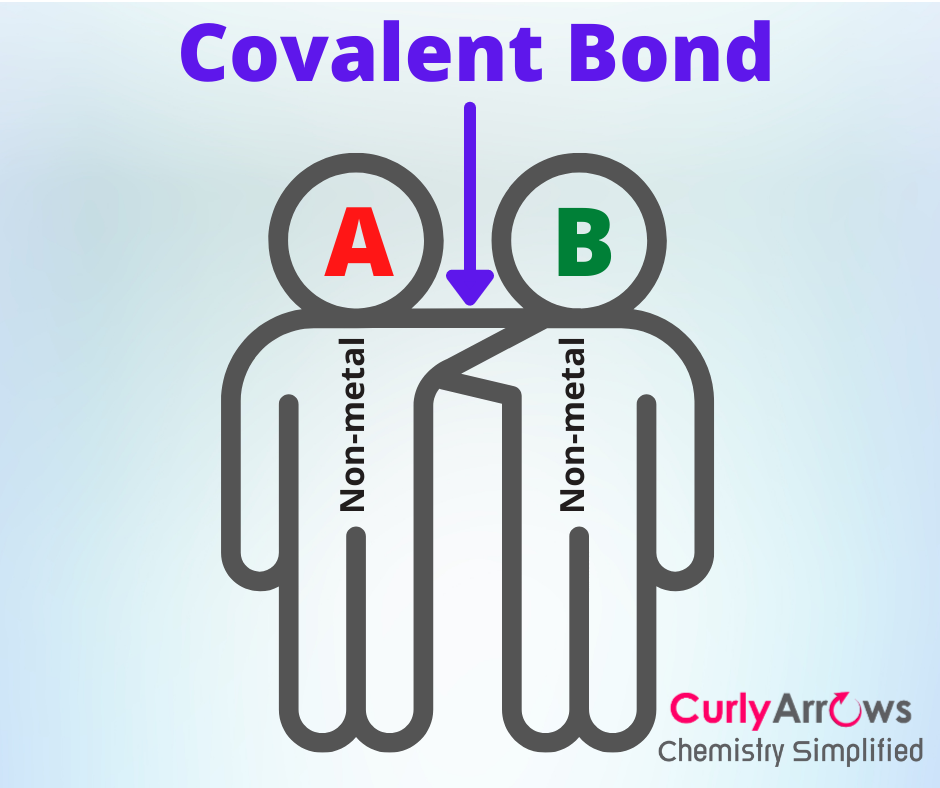
The atoms involved in a covalent bond formation are nonmetal atoms from the p-block of the periodic table. The atoms may be of the same or different types.
The covalent bond formation holds two atoms in attractive force and restricts their linear or translational motion. However, the other motions that the bonded atoms can exhibit are axial rotations and vibrational motion.
Covalent bond-forming reactions are energetically favorable as the products formed are more stable than parent atoms (or molecules).
Covalent bond formation occurs when two radicals combine or in reactions between an electrophile and a nucleophile.
Some atoms form additional covalent bonds (double and triple) over the single bond—for example, alkene (e.g., H2C=CH2) and alkynes (e.g., H2C≡CH2).
Related Chapter - Covalent Bond