Dialysis
Dialysis is a process of diffusion of the colloidal particles through a parchment or an animal membrane to remove excess of an electrolyte or any soluble impurities (crystalloids).

Dialysis is a process of diffusion of the colloidal particles through a parchment or an animal membrane to remove excess of an electrolyte or any soluble impurities (crystalloids).
A dihedral angle is obtained when two planes pass through three atoms and two bonds, of which one bond is common to both planes.
In the below example, plane 1 passes through X-C-C, containing three atoms and two bonds. Similarly, the plane 2 passes through C-C-Y. The separation between the two planes or the angle of intersection is denoted using a dihedral angle (ϴ) in degrees (o).
The redistribution of electrons in an atom, bond, or molecule creates two ends (or poles), one electron-rich negative and the other electron-deficient positive; such an atom, bond, or molecule is said to have a dipole (two poles).
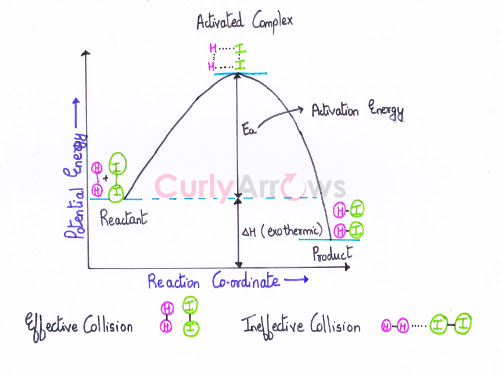
Effective collisions result in product formation due to an increase in the rate of a chemical reaction. It occurs when the two reactant molecules are correctly oriented and have attained the threshold value (or the activation energy value) at the time of the collision.
In the electrochemical series, the electrodes are arranged in the increasing order of their reduction potential under standard conditions of 1M electrolyte concentration, 298 K temperature, and 1 bar atmospheric pressure.
It is also known as the activity series as the activities of two different electrodes towards displacement reaction are compared; whether the electrode under standard reaction condition will have reduction potential or oxidation potential.
A branch of chemistry that deals with the interconversion of chemical energy and electrical energy taking place via the redox reactions.
It studies how a spontaneous redox reaction capable of generating chemical energy converts it into electrical energy. Example, Electrochemical cell.
Or how the use of electrical energy can bring about a non-spontaneous chemical reaction. Example, Electrolytic cell.
An electrode in contact with an electrolyte solution of same ionic nature (for example; Cu electrode in CuSO4 solution, Zn electrode in ZnSO4 solution) tends to either undergo oxidation or reduction due to which there develops a charge separation creating a potential difference.
An electron is a negatively charged elementary particle that constitutes an atom, denoted as e- or β-. The electrons are present in the outer-nuclear region of an atom as clouds.
Electronegativity measures on a scale of 0.8 – 4 an atom’s or group of atoms’ tendency to attract the bond electron pair towards itself, thereby creating partial negative (δ-) and positive (δ+) terminals.
Electrophiles are electron-deficient species that accept electrons from other electron-rich counterparts, the nucleophiles, to form a two-electron covalent bond.